


What Size Breaker For Ev Charger
If you want to install exactly what size circuit breaker you need for your electric vehicle charger, the decisive answer depends on the maximum ampere output of your charger and the national electrical code “the eighty percent rule” for continuous loads. Because electric vehicle charging stations extract power for hours on end, your circuit breaker must be sized to one hundred and twenty-five percent of the charger’s maximum extraction. Specifically, if you want to install a standard 40-amp secondary charger, you must use a 50-amp double-pole circuit breaker. Similarly, a 32-amp electric vehicle charger requires a 40-amp circuit breaker, while a high-powered 48-amp hardwired charger requires a 60-amp circuit breaker. For a basic first-stage charger plugged into a standard wall outlet and extracting 12 amps, a dedicated 15-amp or 20-amp single-pole circuit breaker is required. Always verify your home’s electrical panel capacity and ensure the correct wire gauge is installed (such as a No. 6 US wire gauge for a 50-amp circuit) to ensure a safe, code-compliant charging experience.
Understanding National Electrical Code “Eighty Percent Rule” And Continuous Load
When deciding what size circuit breaker is appropriate for an electric vehicle charger, the most important factor is the national electrical code “80 percent rule”.
Charging an electric vehicle is considered as a “continuous load”. In electrical terms, a continuous load points to any device that extracts a maximum current of three hours or more. Because electric cars take hours to recharge, they fit perfectly into this category.
Under national electrical code guidelines, a continuous load can only safely utilize eighty percent of the total capacity of a circuit breaker. This safety edge prevents circuit breakers and electrical wiring from overheating and creating a fire hazard. Instead, to calculate the correct circuit breaker size from your charger output, you must size the circuit breaker at one hundred and twenty-five percent of the charger’s maximum power draw.
Level 1 Vs. Level 2
Applying the one hundredth and twenty-five rule makes it easy to calculate the exact circuit breaker size you need based on the ampere output of your specific charger. Here’s a detailed breakdown of one of the most common electric vehicle charger configurations:
12 Amp Level 1 Charger: The basic Level 1 charger plugs directly into a standard 120 volt wall outlet. Because they extract 12 amps of power, they require a 15-amp or 20-amp single-pole circuit breaker. This is highly recommended, i.e. this should be a dedicated circuit so there are no other appliances that overload the circuit breaker while your car is charging.
32-amp secondary charger: A popular choice for home charging, a 32-amp charger requires a 40-amp double-pole circuit breaker (32 amps times one hundredth and twenty-five equals 40 amps).
40-Amp Secondary Charger: If you want to install a standard 40-amp secondary charger to achieve faster charging speeds, the math dictates that you must use a 50-amp double-pole circuit breaker (40 amps times 125 percent equals 50 amps).
48-amp hardwired charger: For high-power home charging, a 48-amp charger is often used. Because of their high power output, these chargers are often hardwired directly into the electrical system and require a 60-amp double-pole circuit breaker (48 amps times one hundredth and twenty-five equals 60 amps).
The Importance Of Matching Wire Gauge To Your Circuit Breaker Size
Knowing what size circuit breaker you need for your EV charger installation is only half the equation; pairing that circuit breaker is just as critical as having the correct wire gauge.
Wires act as pipes that act as electricity. If you install a large circuit breaker but use a gauge that is too thin, the wires will melt before the circuit breaker trips, creating a serious fire hazard. You must ensure that the correct wire gauge is installed for your specific circuit capacity.
For example, if you are installing a 40 amp charger on a 50 amp circuit breaker, you must use 6 gauge US wire. Higher amp settings, such as a 60-amp circuit breaker for a 48-amp hardwired charger, will require even thicker wiring to safely handle the current. Always match wire gauge directly to the rated size of the circuit breaker, not only the output of the charger.
Verify Home Electrical Panel Capacity For Regulatory Compliance
Before purchasing an electric vehicle charger or upgrading your circuit breaker, you must always verify the electrical panel capacity of your home.
Adding a 40-amp, 50-amp, or 60-amp double-pole circuit breaker to an existing electrical panel requires a significant amount of available power. Older homes with 100-amp panels may not have the capacity to support a high-powered secondary charger without overloading the main system. If your panel does not have available capacity, you may need a panel upgrade to safely accommodate new dedicated circuitry.
Ultimately, it’s a mandatory step to stick to the 80 percent rule of the National Electrical Code, choose the right single-pole or double-pole circuit breaker, utilize the correct wire gauge (like a No. 6 U.S. wire gauge), and confirm the load capacity of your panel. Following these strict sizing requirements is the only way to ensure a regulated and compliant charging experience for the safety of your electric vehicle.
FAQ About ev charger
Q: What size wire for EV charger?
A: It depends on the circuit breaker. A 50-amp circuit requires 6 AWG of copper wire, while a 40-amp circuit requires 8 AWG. Be sure to check your local electrical code.
Q: Can you install EV charger outside?
A: Yes. Please select a charger with NEMA 3R or NEMA 4 weatherproof rating. For outdoor settings, a hard-wired installation is strongly recommended for safety reasons.
Q: Is 125 amp service enough for EV charger?
A: Yes, provided your home uses gas appliances and has a low electrical load. If your home relies entirely on electricity, you may need a smart load manager or an upgraded electrical panel.
Q: Are all EV charging stations compatible?
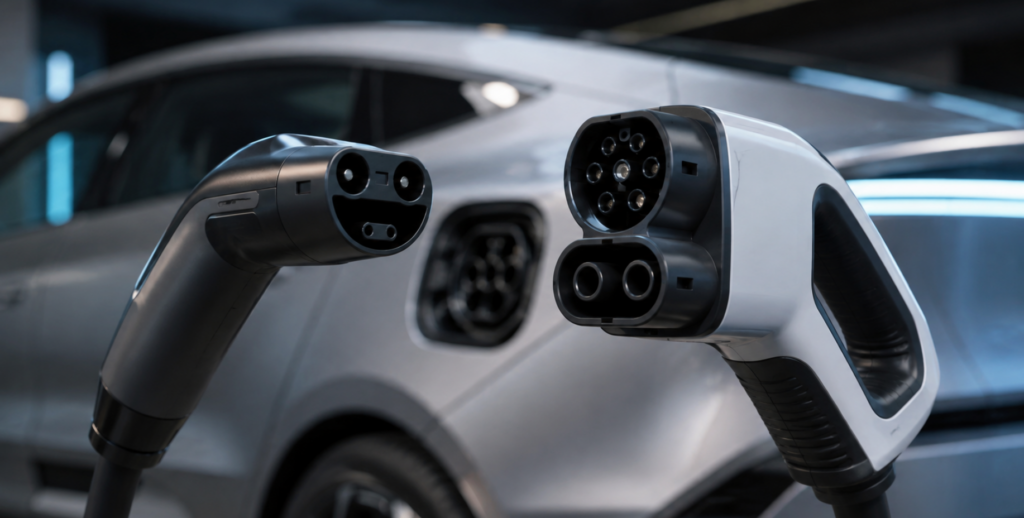
A: The vast majority are. North America uses the J1772 and Tesla NACS connectors. However, simple adapters are readily available and can allow almost any electric vehicle to use any home charger.
Q: How many amps for EV charger?
A: Most Level 2 home chargers output 32 to 48 amps. According to the 80% safety rule, a 48-amp charger needs to be equipped with a dedicated 60-amp circuit breaker.